Spring training season is back, and fields across Volusia County are filling up fast. From Little League diamonds near Gemini Springs Park to adult recreational leagues in DeLand, players of all ages are lacing up their cleats and picking up where they left off. But Florida's early spring heat and humidity mean your body needs more preparation than you might think. Jumping back into throwing, hitting, and fielding without proper conditioning is one of the fastest ways to end your season before it really starts.
Central Florida Bone & Joint Institute sees a spike in baseball-related injuries every February and March. If you or your child is heading into spring ball, call us at (386) 775-2012 before pain becomes a problem.
Why Does Florida's Climate Make Baseball Injuries More Likely?
Florida's spring humidity, which regularly sits between 70–80% even in February and March, affects how muscles and connective tissue perform during warm-up. Muscles don't loosen as quickly as players think they do in warm weather. That false sense of flexibility leads players to skip stretching and jump straight into full-effort throws. That's a mistake we see repeatedly at our practice.
Static stretching before activity has largely been replaced by dynamic warm-up routines for good reason. Dynamic movements, like arm circles, high knees, walking lunges, and lateral shuffles, raise your core body temperature and prepare the specific joints and muscle groups used in baseball. A proper dynamic warm-up takes about 10–15 minutes. Skipping it to save time often costs weeks of missed play due to injury.
What Are the Most Common Baseball Injuries at the Start of the Season?
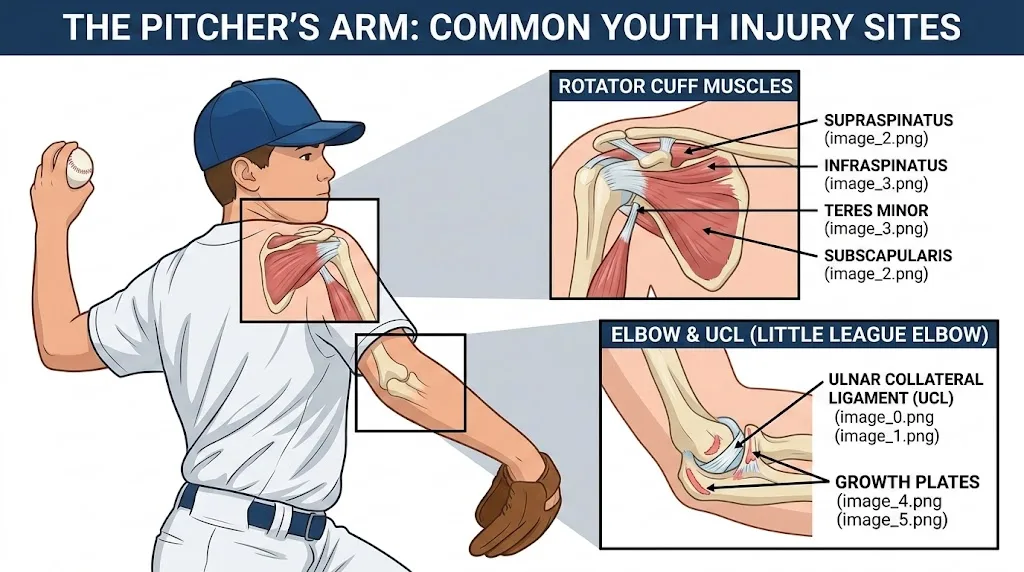
The two injuries we treat most often in early-season baseball are rotator cuff strains and UCL (Ulnar Collateral Ligament) tears. Both involve the throwing arm, and both are largely preventable with the right preparation.
The Rotator Cuff is a group of four muscles that stabilize the shoulder joint. During a throw, these muscles work at high speed under significant load. When a player hasn't thrown consistently over the winter, those muscles lose strength and endurance. Coming back at full velocity in the first week of March puts enormous stress on tissue that isn't ready. Rotator cuff strains can sideline a player for 6–12 weeks. Partial tears sometimes require surgery, with recovery stretching 4–6 months.
The UCL is a small ligament on the inside of the elbow that handles the stress of throwing. You've probably heard of Tommy John surgery — that's the reconstruction procedure performed when the UCL tears completely. Recovery from Tommy John surgery typically takes 12–18 months, which can mean a full season lost for a high school or college player. Partial UCL tears, sometimes called "Little League Elbow" in younger players, are especially common in pitchers who throw too many innings too early in the season.
(Visual Asset: See the anatomy diagram above, "The Pitcher's Arm," which highlights the UCL on the inner elbow and the rotator cuff muscle group on the shoulder.)
How Can Youth Players Protect Their Throwing Arms?
Pitch count limits exist for a reason. USA Baseball's official pitch count guidelines recommend that players aged 7–8 throw no more than 50 pitches per day, players aged 9–10 no more than 75, and players aged 13–16 no more than 95. Yet many youth leagues across Volusia County still see coaches pushing beyond these limits during the excitement of a competitive spring season.
Rest days are just as critical as the pitch count itself. After throwing 61–75 pitches, a player aged 9–12 needs at least 3 days of rest before pitching again. Throwing through fatigue is the number one mechanical breakdown that leads to UCL stress in young arms.
Parents and coaches should watch for these warning signs:
- Complaints of elbow pain on the inside of the joint
- A noticeable drop in velocity or control
- Any reluctance to throw at full effort
These aren't signs of weakness. They're the body signaling that tissue is under more stress than it can handle.
Does Throwing Mechanics Actually Prevent Injuries?
Yes, directly. Poor throwing mechanics force the elbow and shoulder to compensate for inefficiencies in the kinetic chain, putting far greater stress on the UCL and rotator cuff than proper form would generate.
A few common mechanical issues our team sees:
- "Opening up" too early: The hips rotating toward the plate before the arm is in position. This dumps excessive stress on the shoulder.
- Dropping the elbow below shoulder height at release: This puts the UCL at maximum risk, especially during high-velocity throws.
- Throwing across the body: Creates awkward shoulder angles that strain the posterior rotator cuff.
Working with a qualified pitching coach for even 2–3 sessions before the season begins can identify and correct these patterns. For players already experiencing elbow or shoulder discomfort, an evaluation with an orthopedic surgeon in DeLand, Florida, can determine whether a structural issue needs attention before further damage occurs.
How Should You Handle Hydration and Recovery in Florida's Heat?
Florida outdoor sports present real hydration challenges that northern climates simply don't. By March, afternoon temperatures near the St. Johns River corridor can reach 82–85°F, and humidity keeps sweat from evaporating efficiently. Players lose more fluid than they realize.
A practical hydration plan for spring baseball in Central Florida:
- Drink 16–20 oz of water 2 hours before practice
- Consume 6–8 oz every 15–20 minutes during activity
- For sessions lasting over 60 minutes, add an electrolyte drink to replace sodium and potassium lost through sweat
Recovery matters just as much as preparation. After a practice or game, a 10-minute cool-down walk followed by static stretching of the shoulder, forearm, and hip flexors helps reduce next-day soreness. Ice applied to the elbow or shoulder for 15–20 minutes after heavy throwing sessions can significantly reduce inflammation before it becomes a chronic problem.
Players dealing with persistent arm soreness that doesn't resolve in 48–72 hours should not push through it. Our regenerative medicine services offer non-surgical options, including platelet-rich plasma (PRP) therapy, that can help heal partial tendon and ligament injuries faster, often helping players return to activity weeks sooner than rest alone.
For players or parents who can't get into the office easily, we also offer orthopedic telemedicine appointments. A new patient self-pay telemedicine consultation is just $75, and most insurance plans cover virtual visits. It's a quick way to get a professional opinion on arm pain without having to miss school or work for an in-person appointment.
Ready to Start the Season Right? Contact Us Before You're Sidelined
A successful spring baseball season doesn't start on opening day. It starts with conditioning, proper mechanics, smart pitch count management, and knowing when to get your arm looked at before a minor strain becomes a major injury.
Whether you're a Little League parent in Orange City or an adult league player out near Lake Beresford, the team at Central Florida Bone & Joint Institute is here to help you stay in the game. Our orthopedic surgeons in DeLand, Florida specialize in sports-related shoulder and elbow injuries and can get you evaluated quickly so you don't miss more of the season than necessary.
Call (386) 775-2012 to schedule an appointment at our Orange City or Lake Mary location.