Florida doesn't slow down, and neither do its residents. From early morning golf rounds at Riviera Country Club to Saturday pickleball matches at Gemini Springs Park, the Volusia County lifestyle puts real demands on your shoulders. If you've felt a dull ache after a round of golf or noticed your arm tiring faster than usual during a swim, your rotator cuff may be trying to tell you something. Central Florida Bone & Joint Institute can help you figure out what's going on before a minor strain turns into a major setback. Call (386) 775-2012 to schedule an evaluation.
What Exactly Is the Rotator Cuff?
The rotator cuff is a group of four muscles and their tendons that surround the shoulder joint. These muscles, the supraspinatus, infraspinatus, teres minor, and subscapularis, work together to keep the ball of your upper arm seated firmly in the shoulder socket. They also power most of the arm movements you rely on every day: reaching overhead, swinging a golf club, pulling a fishing rod, or paddling a kayak through the St. Johns River.
Here's why it's prone to injury: the tendons of the rotator cuff pass through a narrow space beneath the top of the shoulder blade. Repetitive overhead motions gradually wear on those tendons over time. Add Florida's year-round outdoor activity season, where residents don't get the natural recovery breaks that colder climates force on their athletes, and it's easy to see why rotator cuff issues are among the most common shoulder complaints we treat.
What Are the Early Warning Signs of a Rotator Cuff Injury?
Early rotator cuff symptoms are easy to dismiss as normal soreness. But there are specific patterns that point to a real problem rather than typical post-activity muscle fatigue.
Signs that warrant attention:
- Pain on the outside or front of the shoulder that lingers more than 3-5 days after activity
- Aching at night, especially when lying on the affected shoulder
- Weakness when lifting your arm to the side or overhead
- A clicking or popping sensation with certain arm movements
- Difficulty reaching behind your back, such as when fastening a seatbelt or tucking in a shirt
General soreness after a hard workout usually resolves with 48-72 hours of rest. Rotator cuff strain tends to linger and often gets worse with continued activity. A full tear typically causes sharper, more immediate weakness, sometimes making it difficult to raise the arm at all.
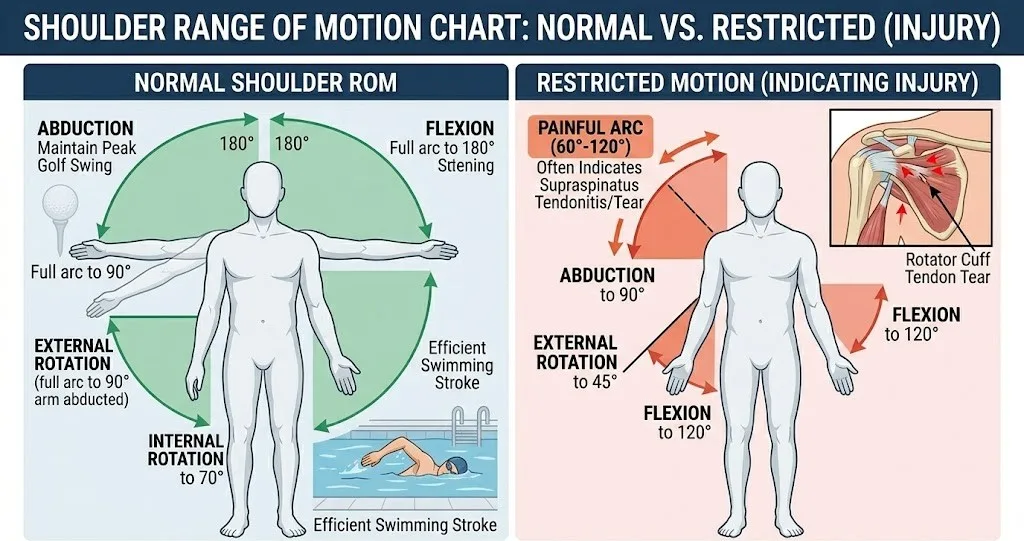
[Range of Motion Reference: Normal vs. Restricted Shoulder Motion]
Normal shoulder range of motion benchmarks:
- Forward flexion: 0-180 degrees
- Abduction (arm out to side): 0-180 degrees
- External rotation: 0-90 degrees
- Internal rotation: 0-70 degrees
Reduced motion in any of these ranges, particularly external rotation or abduction, may signal rotator cuff damage and is worth getting evaluated.
Why Do Florida Activities Put Extra Strain on Your Shoulder?
Golf, pickleball, boating, and swimming all involve repetitive shoulder motion. That's well understood. What most residents don't realize is that Florida's year-round outdoor season removes the natural off-season recovery that athletes in northern states get automatically.
A golfer in Ohio might play actively from April through October, around 6 months. Here in Orange City and across Volusia County, many residents play 10-12 months a year. That's 40-60% more cumulative shoulder stress annually compared to seasonal athletes in colder climates.
Pickleball in particular has seen an explosion in participation among residents over 50, a demographic that already has some age-related tendon changes. The overhead serve, the quick lateral reaches, and the repeated swing motion all load the supraspinatus tendon, the most commonly injured part of the rotator cuff. Studies show that approximately 30% of people over age 60 have a partial rotator cuff tear, often without knowing it, because symptoms develop gradually.
Swimming is lower impact but not risk-free. Freestyle and butterfly strokes place the shoulder in an impingement-prone position thousands of times per session.
Preventive Exercises to Protect Your Shoulder
You don't need a gym membership or a lot of equipment. These exercises are used routinely to maintain the shoulder strength and mobility that keep active Floridians doing what they love.
External Rotation with Resistance Band
Anchor a light resistance band at elbow height. Keep your elbow bent at 90 degrees and pinned to your side, then rotate your forearm outward against the band. Do 3 sets of 15 repetitions. This directly strengthens the infraspinatus and teres minor, the two muscles most responsible for shoulder stability during overhead and throwing motions.
Scapular Retractions
Sit or stand with good posture. Squeeze your shoulder blades together and hold for 5 seconds, then release. Repeat 15-20 times. Poor scapular positioning is one of the main reasons shoulder impingement develops in golfers and paddlers.
Cross-Body Stretch
Bring your arm across your chest and hold it gently with the opposite hand for 30 seconds. Switch sides. Doing this before and after activity improves posterior shoulder flexibility, which reduces the internal impingement common in overhead athletes.
Pendulum Exercise
Lean slightly forward, let your arm hang freely, and make small, gentle circles. This decompresses the shoulder joint and is a good daily warm-up for anyone who starts their morning on the golf course or pickleball court.
Aim for 4-5 days per week with these exercises. It takes roughly 6-8 weeks of consistent work to see meaningful improvement in shoulder stability.
When Should You See an Orthopedic Specialist?
Rest and exercises help most minor strains. But certain situations need professional evaluation sooner rather than later.
See a specialist if:
- Pain has lasted more than 4-6 weeks despite rest and modified activity
- You've lost noticeable strength or range of motion
- Shoulder pain is waking you up at night consistently
- The shoulder gave out suddenly during an activity
- You heard or felt a pop at the moment of injury
Getting an early MRI can identify partial tears before they become full tears. A partial rotator cuff tear treated conservatively, with physical therapy and possibly a corticosteroid injection, has a success rate of around 73-80% without surgery. A full-thickness tear that's been left untreated too long often requires surgical repair and carries a recovery timeline of 4-6 months before returning to sport.
Our team at Central Florida Bone & Joint Institute specializes in active patients who want to get back to their sport, not just manage pain on the sideline. For patients who prefer to start with a remote consultation, we also offer orthopedic telemedicine appointments, with self-pay rates starting at $75 for new patients. It's a fast, convenient option for residents across the area who want a professional opinion without rearranging their day.
For those dealing with chronic partial tears or tendon degeneration, our regenerative medicine services, including platelet-rich plasma (PRP) therapy and stem cell treatment, offer non-surgical options that support your body's natural healing process.
Working with an orthopedic surgeon in Orange City, Florida who understands the demands of Florida's active lifestyle makes a real difference in treatment planning. A specialist familiar with the physical patterns of golfers, paddlers, and pickleball players will approach your care differently than a general practitioner would.
Keep Your Shoulder in the Game
Florida living is an active lifestyle, and your shoulder health directly determines how long you can keep enjoying it. Catching a rotator cuff issue early, whether through preventive exercises, knowing your warning signs, or getting a timely evaluation, keeps a manageable problem from becoming a surgical one.
Don't wait until the pain is ruling your mornings or keeping you off the course. Contact Central Florida Bone & Joint Institute at (386) 775-2012 to schedule an appointment with an orthopedic surgeon in Orange City, Florida, who will build a plan around your goals and your lifestyle. Our Orange City office at 2745 Rebecca Lane is open Monday through Friday, 8 am to 5 pm.