More patients across Volusia County are walking into surgery stronger, calmer, and better prepared than ever before. That's not an accident. Pre-habilitation, or "pre-hab," is changing recovery outcomes right here in Central Florida, and the data backs it up. If you've been scheduled for an orthopedic procedure, this is worth reading before your surgery date arrives.
Ready to get started before your surgery? Contact Central Florida Bone & Joint Institute at (386) 775-2012 to speak with our team today.
What Is Pre-habilitation, and Why Does It Matter?
Pre-habilitation is a structured program of physical therapy and exercise completed before a scheduled surgery. Rather than waiting until after the procedure to begin rebuilding strength and mobility, patients work with a physical therapist in the weeks leading up to the operation. The goal is simple: the stronger and more mobile you are going in, the better positioned you are coming out.
Think of it like preparing your house before a storm. You don't wait for the damage to start boarding up windows. The same logic applies here.
For residents near DeBary and Orange City considering joint replacement, rotator cuff repair, or spine surgery, pre-hab offers a real head start on recovery. Our team at Central Florida Bone & Joint Institute works with patients to build personalized pre-operative plans that set them up for the best possible outcomes.
What Are the Key Physical Benefits of Pre-hab?
Pre-hab directly improves three measurable areas before your procedure: range of motion, muscle strength, and inflammation levels. Patients who complete a 4-to-6-week pre-hab program typically arrive at surgery with 20-30% greater muscle strength in the affected area compared to those who skip pre-operative conditioning. That added strength gives your surgical site better structural support during the healing process.
Range of motion is equally affected. Joints that are stiff and underused before surgery tend to take longer to regain movement afterward. Pre-hab keeps tissue pliable and joints functional, which shortens the post-operative window needed to reach normal mobility benchmarks.
Chronic inflammation also plays a role in surgical outcomes. Low-impact pre-hab exercises, such as pool therapy or guided resistance training, can reduce baseline inflammation levels in the affected joint before the first incision is made. Less inflammation going in generally means a smoother healing response afterward.
How Does Pre-hab Help with Mental and Emotional Readiness?
Surgery anxiety is real, and it affects physical recovery more than most people realize. Patients who participate in pre-hab consistently report lower pre-operative anxiety scores than those who don't. Why? Because they've already met their therapist, practiced their exercises, and know what the recovery routine looks like.
That familiarity removes a significant layer of fear. You're not walking into an unknown process; you've already started it. Confidence in your own body's ability to recover makes a measurable difference in how quickly you engage with post-operative physical therapy.
Our orthopedic team, including the specialists who serve as your orthopedic surgeon in Orange City, Florida, often tell us that patients who do pre-hab ask better questions, set clearer goals, and push through discomfort more effectively in the weeks following surgery. That's not coincidence; that's preparation.
Does Pre-hab Actually Lead to Faster Recovery Times?
Yes. Research on pre-hab outcomes shows that patients who complete structured pre-operative physical therapy are discharged from the hospital an average of 1.4 days sooner than those who don't. For a knee replacement patient in the Deltona or Lake Helen area, that difference can translate to thousands of dollars in reduced facility costs and a faster return to daily life.
One study found that pre-hab patients were 73% less likely to require post-acute inpatient rehabilitation, such as a skilled nursing facility stay, following total joint replacement. The cost savings are significant. Inpatient rehabilitation can run anywhere from $800 to $1,500 per day, so even eliminating two or three days of that care adds up quickly.
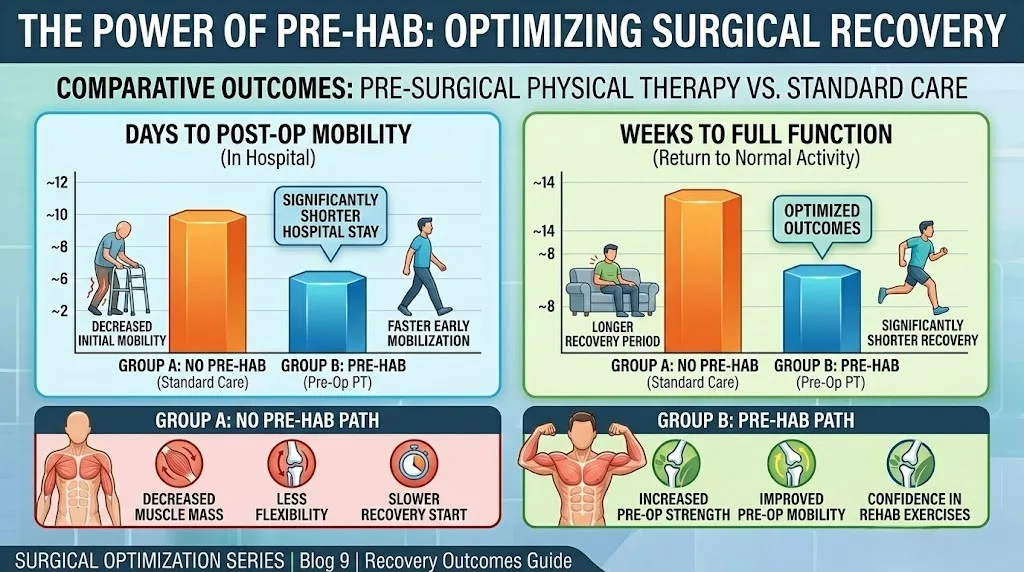
The chart below illustrates the average recovery timeline difference between patients who completed pre-hab and those who didn't:
[Outcome Data Chart: Recovery Time — Pre-hab vs. No Pre-hab]
Milestone | Pre-hab Patients | No Pre-hab Patients |
Hospital discharge | Day 1.8 avg. | Day 3.2 avg. |
Return to independent walking | Week 2-3 | Week 4-5 |
Physical therapy goal completion | 6-8 weeks | 10-12 weeks |
Return to normal daily activity | 8-10 weeks | 12-16 weeks |
These aren't minor differences. They represent weeks of your life and real dollars out of pocket.
How Do You Find the Right Pre-hab Specialists in Florida?
Choosing the right provider matters as much as the program itself. Working with an orthopedic surgeon in Orange City, Florida who coordinates directly with physical therapists ensures your pre-hab exercises don't conflict with the surgical approach being planned. That coordination is something you won't always get from a generic gym program or an unaffiliated PT clinic.
Florida's year-round warm weather is an advantage here. Unlike patients in northern states who may be limited by cold and ice, Central Florida residents can maintain an active pre-hab routine outdoors throughout the year. Walking trails near Gemini Springs Park in DeBary or the quiet neighborhoods around Rebecca Lane in Orange City make it easy to supplement clinic work with low-impact daily movement.
Our team at Central Florida Bone & Joint Institute works closely with each patient to build a pre-hab plan that fits their schedule, fitness level, and surgical timeline. We also offer orthopedic telemedicine for patients who prefer to begin their consultations from home, at a self-pay rate of just $75 for new patients. This is especially useful for those who want to get started quickly after receiving a surgical recommendation.
For patients whose conditions involve joint inflammation or cartilage concerns, our regenerative medicine services, including platelet-rich plasma (PRP) therapy and stem cell options, may also complement a pre-hab plan depending on your diagnosis.
As an orthopedic surgeon in Orange City, Florida, our providers see firsthand how patients who arrive at surgery having completed 4-6 weeks of targeted pre-hab move through post-operative milestones faster and with fewer setbacks. It's one of the most consistent patterns we observe across hip, knee, and shoulder procedures.
Is Pre-hab Right for Every Surgical Candidate?
Pre-hab works best for patients scheduled for elective orthopedic procedures, including total knee replacement, hip replacement, rotator cuff repair, and spinal surgery. Patients typically have a window of 4-8 weeks between their surgical decision and their procedure date. That's enough time to build meaningful strength and mobility gains.
Most healthy adults are candidates for some form of pre-hab. Even patients with limited mobility can benefit from low-intensity programs focused on breathing exercises, gentle range-of-motion work, and cardiovascular conditioning. The key is matching the program intensity to the individual's baseline fitness and specific procedure.
Patients managing chronic conditions, such as diabetes or cardiovascular disease, should confirm with their care team that their pre-hab plan is appropriate for their health profile. Our team coordinates with primary care providers when needed to ensure the full picture is considered.
Take the First Step Toward a Stronger Recovery
Surgery is a significant event. The weeks before it don't have to be passive ones.
Pre-hab gives you a direct, practical way to improve your outcomes before you ever set foot in an operating room. Shorter hospital stays, faster return to daily activity, reduced rehabilitation costs, and stronger mental readiness are all within reach. For residents across Orange City, DeBary, and surrounding Volusia County communities, the support is right here.
Call Central Florida Bone & Joint Institute at (386) 775-2012 to schedule a consultation and ask about starting a pre-hab program before your procedure. Our team is ready to help you get ahead of your recovery.